



Not All Leather Is Made the Same: Why Our Leather Teether Is Vegetable Tanned
Every leather good starts the same way: as a raw hide. What happens next decides everything about what it becomes.
That in-between step is called tanning. It's the process that turns a hide that would rot into a material that lasts. And there are really only two roads a tannery can take. One is old, slow and honest. The other is fast, cheap and built for volume.
When you're choosing a natural teether, something your baby is going to hold, gnaw on and drag around the house, the road matters. So let's walk through it.
Two roads: vegetable tanned or chrome tanned
Vegetable tanning is the original method. Hides soak in tannins pulled from tree bark, wood and leaves. The tannins slowly bind to the fibers of the hide over weeks, sometimes months. It takes patience and a craftsman's eye, which is why fewer tanneries still do it.
Chrome tanning came along in the late 1800s, built for the industrial age. Hides are tumbled in drums with chromium salts and other chemicals. The whole job can be done in about a day. It's faster, cheaper and easier to dye in any color you want.
Both produce "leather." But they don't produce the same thing. And the label on most products won't tell you which one you're holding.
Good hide vs. cheap hide: vegetable tanned vs. chrome tanned leather
This is where the difference shows up in your hands.
|
|
Vegetable tanned |
Chrome tanned |
|---|---|---|
|
Tanned with |
Plant tannins from bark and wood |
Chromium salts and synthetic chemicals |
|
Time to tan |
Weeks to months |
About a day |
|
Feel |
Firm, dense, holds its shape |
Soft and stretchy from the start |
|
With age |
Darkens into a rich patina, gets better with use |
Cracks, peels or wears thin |
|
Holds a stamp |
Yes, crisp and deep |
Poorly |
|
Runoff |
Plant-based tannins |
Chromium-laden wastewater |
It's built to last. Veg-tan leather is dense and sturdy. Instead of breaking down, it softens and molds to the hands that use it. Over time it deepens from a pale tan to a warm honey brown. That color change is called a patina, and leatherworkers prize it.
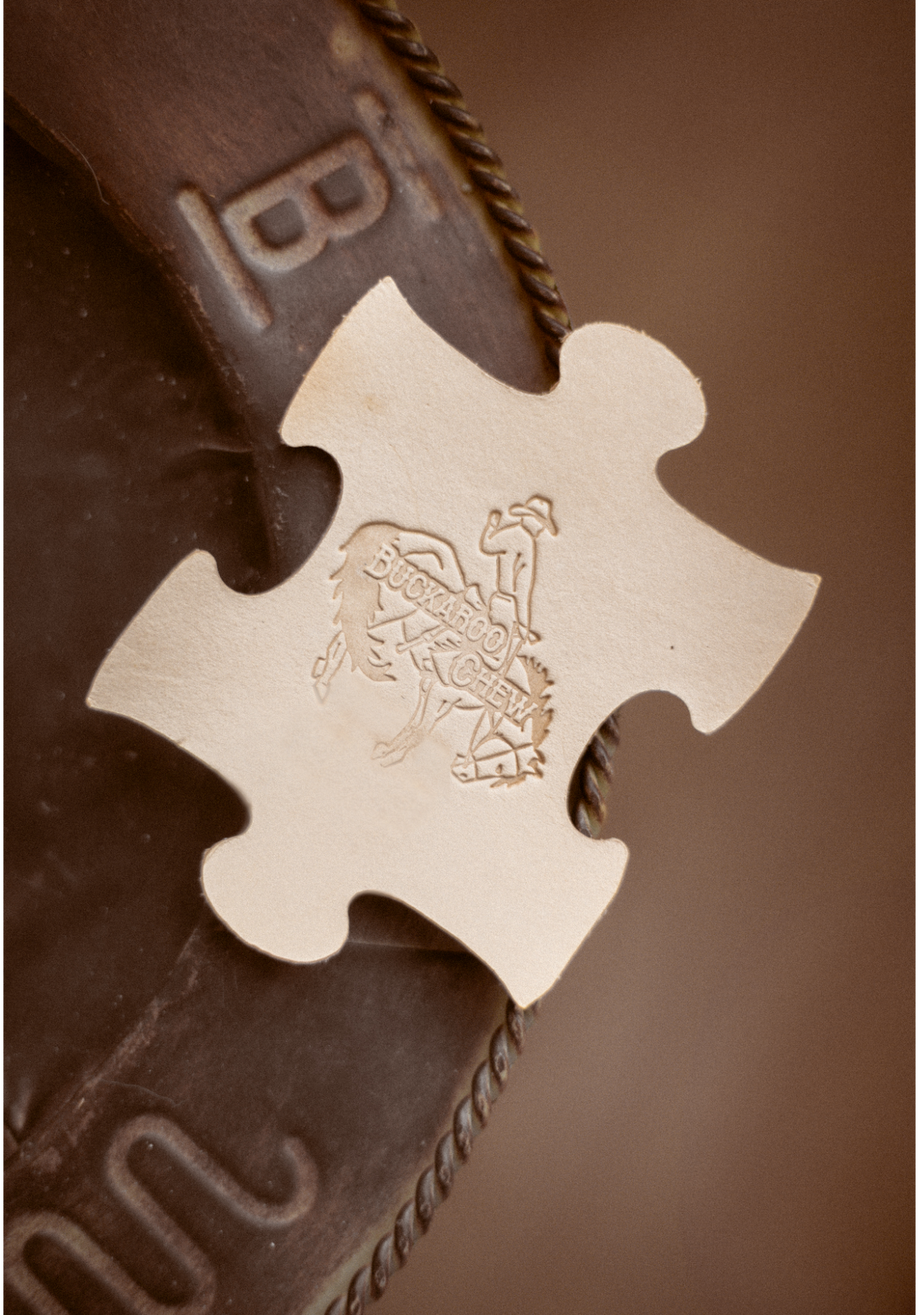
It holds a mark. Because the fibers are firm, veg-tan takes a deep, clean impression. That's why our bronc rider stamp sits crisp in every teether. Chrome-tanned leather is too soft and springy to do that well.
It's easier on the land. Chrome tanning produces wastewater loaded with chromium. Near big tannery hubs overseas, that runoff has fouled rivers and the communities who live along them. Under some conditions, the chromium in chrome leather can also convert to hexavalent chromium, a known toxic compound. It's enough of a concern that Europe caps how much of it is allowed in leather that touches skin. Vegetable tanning skips the chrome entirely.
The rarer road: chrome-free leather tanned with mimosa bark
About 90% of the world's leather is chrome tanned. Ours is in the other 10%.
Our leather is tanned with plant tannins, mostly from mimosa bark. Mimosa (also called black wattle) is a tree whose bark is naturally rich in tannins. Tanners have relied on it for generations because it gives leather a firm body and that warm, natural color. No chrome. No shortcuts.
It's the same way homesteaders did it. Long before there were chemical drums and one-day turnarounds, folks tanned hides with oak, hemlock and whatever bark the land gave them. Saddles, boots and tack were built this way to last a lifetime of hard work.
We go for the old way. Not because it's trendy, but because it's proven. Old ways for a reason.
How to tell if leather is vegetable tanned
You don't need to be a leatherworker to spot good hide. A few things to look for:
- Check the edge. Cut veg-tan shows a solid tan or brown core all the way through. Chrome-tanned leather often shows a bluish-gray line in the middle, a leftover from the chrome bath.
- Smell it. Veg-tan smells earthy and woody, like a tack room. Chrome leather tends to smell more like chemicals.
- Feel it. Veg-tan is firm and a little stiff at first, then softens with use. Chrome leather starts floppy.
- Watch it age. Veg-tan darkens and gets richer with handling and sunlight. Chrome leather mostly stays the color it started.
- Ask. A brand that uses veg-tan will be glad to tell you. If they can't answer, that's an answer too.
Tested and simple: a third-party tested leather teether
Good materials are where it starts. Proof is where it has to end.
Every Buckaroo Chew teether is third-party tested through Intertek, one of the largest independent testing labs in the world. Each production run is backed by lab reports and a Children's Product Certificate (CPC). That's the document that shows a children's product meets U.S. Consumer Product Safety Commission requirements. It's not a sticker we made up. It's the real paperwork, and we've done it for every run.
Our tallow balm keeps it simple too: beef tallow and chamomile. That's the whole list. Nothing synthetic added. It's gone through its own toxicological risk assessment, and it passed. We work a little tallow into the leather itself, the same way old-timers conditioned saddles and boots to keep leather supple.
Why I made it
I made this for my own baby girl.
When she started teething, I went looking for something to hand her. Everything on the big-box shelves was plastic or silicone, and the more I read about what goes into those, the less it sat right with me. I grew up around horses and leather. I knew what good hide was and how long it lasts. So I started there, with a plastic-free leather teether made the old way.
Then I went through every avenue I could find to make sure it was safe. Lab testing. Certificates. Risk assessments. Back-and-forth with the testing lab until every box was checked. It passed every safety test with flying colors.
Made for my own babies. Safety first. That hasn't changed, and it never will. I believe the Lord put good things in this world for us to use, and our job is to use them well and honestly.
See it for yourself
Not all leather is made the same. Hold a Buckaroo Chew Puzzle Chew and you'll feel it: the weight, the firm edge, the deep bronc rider stamp. Then watch it darken a little more every month your little one carries it around.
Shop the Puzzle Chew vegetable tanned leather teether and our Chamomile Tallow Balm at buckaroochew.com.